Shivani
September 1, 2026
Workspaces and Computer Controls: NonBioS for Portfolio Hackers
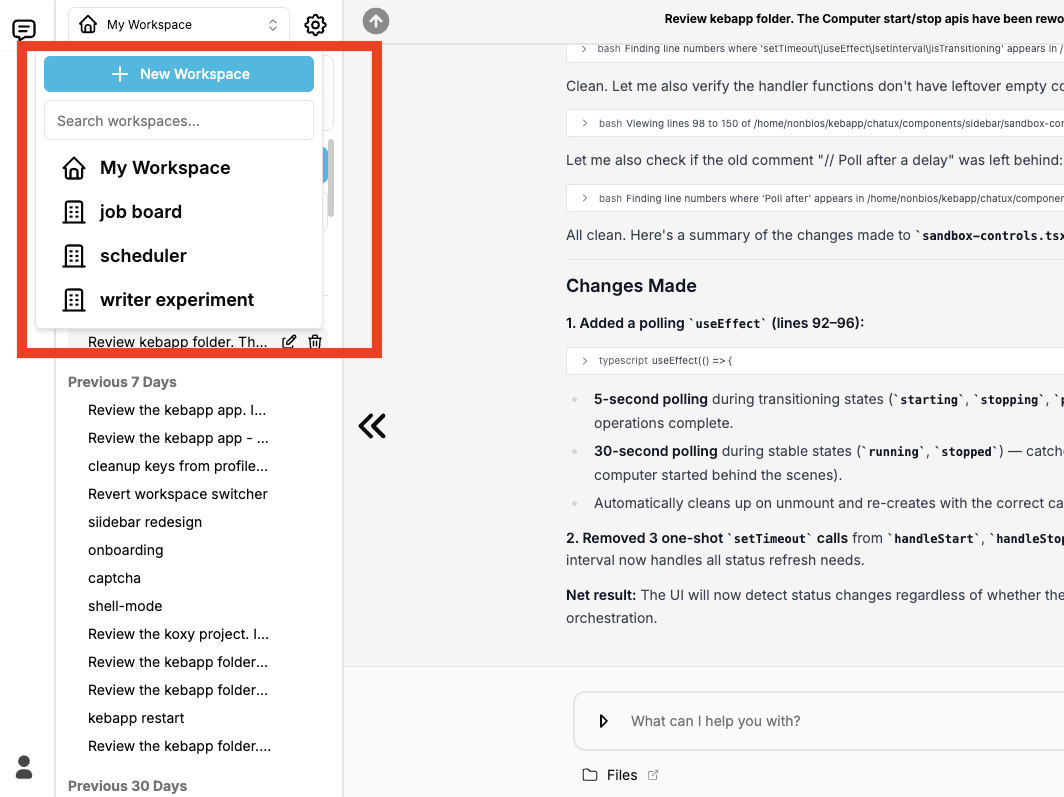
Two shipped features: multiple workspaces, one per project - and a real power switch for your computer.


These models represent significant architectural shifts. We're doing a gradual rollout to gather real-world feedback before making them our primary recommendations. That said, both models are ready for production use right now. nonbios-1.1 and nonbios-1.13 remain available and fully supported.
Author:
Published:
Updated:

We're releasing two experimental models today that represent significant architectural breakthroughs in AI-powered software development.
But first, let me explain the foundation these models are built on.
Most AI agents try to remember everything. We took the opposite approach - we invented Strategic Forgetting, an algorithm that continuously prunes an agent's memory to keep it sharp and focused.
Think about how you work. When you're deep in debugging a complex issue, you naturally filter out background noise—the conversation happening across the room, the email notification, the tangential code comments. You keep what matters for the task at hand and let everything else fade. That's exactly what Strategic Forgetting does.
Here's how it works:
We evaluate information retention based on several key factors.
Relevance scoring - we assess how directly information contributes to the current objective versus being tangential noise.
Temporal decay - information gets weighted by recency and frequency of use; rarely accessed context naturally fades.
Retrievability - if data can be easily reconstructed from system state or documentation, it's a candidate for pruning.
And source priority - user-provided context gets higher retention weight than inferred or generated content.
The algorithm runs continuously during coding sessions, creating a dynamic "working memory" that stays lean and focused. Instead of drowning in context, the agent maintains laser focus on what actually matters.
It's not perfect - agents do lose focus eventually and need to reboot, just like humans getting tired by end of day and needing sleep. Read a novel for breakfast, and you might need a nap by noon. But within their working sessions, they maintain peak performance far longer than traditional approaches.
Today's releases represent a fundamental reimagining of how context engineering works within Strategic Forgetting. We've built a completely new architecture that doesn't just prune better - it understands better.
Nearly 2x faster than nonbios-1.13, but speed is only part of the story.
We achieved this through two fundamental innovations. First, we parallelized key parts of our Strategic Forgetting algorithm, yielding a 25% speed boost. But the real breakthrough came from our new context engineering architecture.
This new architecture helps nonbios-1.135 "converge" on correct solutions dramatically faster. It remembers key details twice as well as 1.13, which means it not only works faster—it solves problems where 1.13 would simply give up. The cumulative effect is roughly 2x performance on software engineering tasks.
And since we charge by the minute, faster execution means more bang for your buck. You're getting better results in half the time.
Built on Claude Opus 4.6 and incorporating the same architectural advances as 1.135, nonbios-1.141 is something different entirely.
In our testing, it solved complex bugs that every other model in our lineup failed on. Not some bugs. Not most bugs. Every single challenging case we threw at it. Even we were shocked by the results.
Here's a real example: We had a complex React bug that nonbios-1.13 struggled with for almost 10 hours, proposing multiple wrong solutions along the way. nonbios-1.141 isolated the exact issue in 5 minutes and one-shot the fix.
But 1.141 isn't perfect. On another React bug, it initially proposed the wrong solution but when we pointed out the inadequacy, it quickly converged to the correct fix.
The combination of our new context engineering architecture and Claude Opus 4.6's capabilities creates debugging performance we haven't seen before. There's a tradeoff - 1.141 is dramatically slower than other models. But when you're hunting a critical bug that's been burning hours or days, speed takes a back seat to actually solving the problem.
These models represent significant architectural shifts. We're doing a gradual rollout to gather real-world feedback before making them our primary recommendations. That said, both models are ready for production use right now. nonbios-1.1 and nonbios-1.13 remain available and fully supported.
Quick signup, give NonBioS a high-level instruction, see progress within minutes. Your first multi-hour session is on the house.
No Credit Card Required