Amit
March 23, 2026
The Best Firebase Alternative
The Best Firebase Alternative for Developers Who Want Control


Why Smart Builders Choose AI-Assisted Code Over No-Code
Author:
Published:
Updated:

Here's the uncomfortable truth about Bubble that nobody talks about: you're investing months learning a proprietary visual programming system that you'll eventually have to abandon.
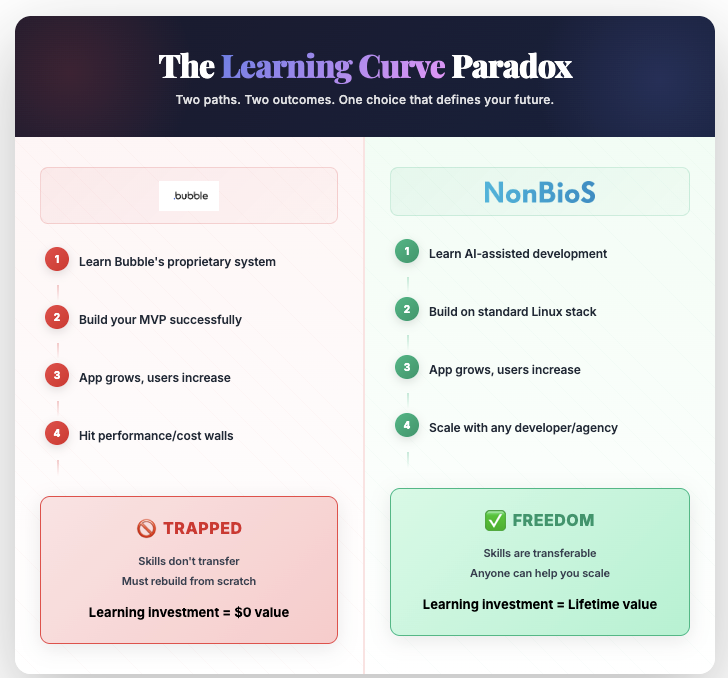
Think about it. You spend weeks mastering Bubble's workflow engine, understanding its database constraints, learning its quirky ways of handling loops and conditions. You become proficient at building within its limitations. You've climbed the learning curve.
Then your app succeeds.
And that's when you discover the cruel irony: the better you get at Bubble, the more trapped you become. Every hour you invest in mastering Bubble's proprietary system is an hour spent learning skills that won't transfer anywhere else. You can't take your Bubble expertise to another platform. You can't export your code. You can't hire developers who know "real" programming to help scale your app.
You've invested in a dead-end skill.
One developer captured this moment perfectly in a forum post:
"I'm lying in bed right now, feeling defeated. Bubble, which I once thought of as a friend, now feels like a foe."
This is the graduation crisis that hits every successful Bubble founder. You've outgrown the platform, but you're stuck. Rebuilding from scratch feels impossible. Staying means escalating costs and platform limitations. You're trapped by your own success.
But what if there was a different path?
NonBioS also has a learning curve. Let's be honest about that. You'll need to understand basic Linux commands, work with databases, and think in terms of actual code rather than visual workflows.
But here's the critical difference: every skill you learn with NonBioS is transferable and valuable.
When you learn to work with MySQL databases on NonBioS, you're learning MySQL - a skill used by millions of developers worldwide. When you learn to deploy on Linux, you're learning Linux - the foundation of modern web infrastructure. When you write code with AI assistance, you're learning actual programming languages that work everywhere.
If you ever need to move away from NonBioS, you can. Your code is yours. Any developer can help you. Your database is standard MySQL or PostgreSQL. Your infrastructure is standard Linux. Nothing is proprietary. Nothing locks you in.
This is the fundamental difference: Bubble's learning curve leads to a dead end. NonBioS's learning curve leads to genuine technical capability.
Let me tell you a story that plays out every day in the Bubble community.
Sarah built a marketplace app on Bubble. She spent three months learning the platform, building her MVP, and launching to her first users. The app worked. Users loved it. Growth started happening.
Six months later, Sarah's monthly Bubble bill hit $500. Then $800. Her workload units were spiking unpredictably. She needed custom features that Bubble couldn't handle. Performance was degrading as her database grew. Enterprise customers were asking for code audits and on-premise deployment options.
Sarah had two choices: stay on Bubble and watch costs spiral while hitting more limitations, or rebuild everything from scratch in real code.
She chose to rebuild. It took four months and cost her $30,000 in developer fees. All those hours she spent mastering Bubble? Worthless. All that Bubble-specific knowledge? Couldn't transfer to the new codebase.
This is the success paradox: the more successful your Bubble app becomes, the more urgently you need to leave Bubble. Your success becomes your trap.
Now imagine Sarah had started with NonBioS instead. Same three-month learning curve to build her MVP. But when growth hit, she didn't need to rebuild. She just scaled her infrastructure - added more server capacity, optimized her database queries, implemented the custom features she needed. Her code was hers. Her costs were predictable. Her technical skills were valuable and transferable.
The learning curve was similar. The outcome was completely different.
Let's break down why Bubble is fundamentally a bad bet for anyone building a serious application:
The Proprietary Stack Problem: Bubble uses its own visual programming language, its own database system, its own infrastructure. None of it is standard. None of it transfers. You're learning a language that only works on one platform - a platform you'll eventually need to leave.
Compare this to NonBioS, which uses standard Linux, standard databases (MySQL/PostgreSQL), standard programming languages. Every skill you learn is valuable beyond the platform. If you hire a developer, they already know these technologies. If you need to migrate, your code works anywhere.
The Cost Escalation Problem: Bubble's workload-based pricing means success equals financial stress. One viral moment could 10x your costs overnight. You have no control over optimization because you don't control the infrastructure.
A frustrated user described it perfectly: "What happens when this scales? Astronomical costs?"
With NonBioS, you pay for your VM infrastructure - fixed, predictable costs. When you need to scale, you add capacity on your terms, at your pace. No surprises. No workload spikes bankrupting you overnight.
The Customization Wall: Bubble is excellent for standard CRUD applications. But the moment you need something custom - a complex algorithm, a specific integration, advanced database queries - you hit the wall. Users report fundamental limitations: "Inability to natively make a loop", "Inability to create complicated constraints", "Real code is always going to win out for performance and flexibility."
With NonBioS, if you can code it (or describe it to the AI), you can build it. No platform limitations. No waiting for Bubble to add features. No workarounds for basic programming concepts.
The Lock-In Problem: This is the big one. You cannot export your code from Bubble. Ever. Your application is permanently tied to Bubble's infrastructure. If Bubble changes pricing, you pay. If Bubble deprecates features, you adapt. If Bubble shuts down, you're done.
One user captured the fear:
"Applications built on this platform remain tied to... The main things you have to worry about are customization limits, not owning the code, recurring fees, selling the app in the future, scaling."
With NonBioS, you own your code. You can deploy it anywhere. You can sell it easily. You can hire any developer to work on it. You control your destiny.
Here's where NonBioS gets interesting. Yes, there's a learning curve. But you're not climbing it alone.
The NonBioS AI agent acts as your pair programmer, your DevOps engineer, your database administrator. You describe what you want in plain English. The AI writes the code, sets up the infrastructure, handles the deployment.
You're learning by doing, with an expert guide. Every command the AI runs, you see. Every file it creates, you can examine. Every decision it makes, it explains. You're not just building an app - you're learning real development skills.
Compare this to Bubble, where you're learning by clicking through a proprietary visual interface. You're memorizing where buttons are, not understanding how systems work. When you hit a limitation, you're stuck. When you need help, only other Bubble users can assist.
With NonBioS, when you hit a challenge, any developer can help. The AI can help. Online tutorials can help. Your code is standard, your infrastructure is standard, your problems have standard solutions.
Bubble promises ease. No coding required. Visual development. Fast launches. And it delivers on those promises - for a while.
But "easy" has a hidden cost. That ease comes from abstraction, from hiding complexity, from making decisions for you. And those decisions lock you in.
When you build on Bubble, you're renting convenience. When you build with NonBioS, you're investing in capability.
The learning curves are comparable. Both take time to master. But one leads to genuine technical ownership, transferable skills, and unlimited potential. The other leads to platform dependency, proprietary knowledge, and eventual migration pain.
NonBioS is right for you if:
You're a technical founder who can code but wants to move faster. You understand the value of owning your code. You want AI assistance without platform lock-in. You need infrastructure without DevOps complexity.
You're graduating from no-code. You started with Bubble, learned the basics, and hit the limitations. You're ready for real code but want guidance. You value ownership over convenience.
You're building something serious. This isn't a weekend prototype. You need your app to scale. You need predictable costs. You need to own your code for investors, for customers, for your own peace of mind.
You're willing to learn. You understand that real capability requires real learning. You're not looking for the easiest path - you're looking for the right path.
NonBioS is NOT right for you if:
You have zero technical background and zero interest in learning. You need 100% visual development. Your app will stay simple forever. You're building a throwaway prototype.
For those use cases, Bubble is fine. But if you're building something real, something that needs to scale, something you need to own - the learning curve investment in NonBioS pays off from day one.
If you're already on Bubble and feeling trapped, here's the good news: migrating to NonBioS is faster than you think.
The AI agent can help you rebuild your application in weeks, not months. You describe your Bubble app's functionality. The AI generates the database schema, builds the features, sets up the infrastructure. You review, test, and refine.
Your data exports from Bubble as CSV or via API. The AI helps you import it into standard databases. Your integrations rebuild with actual API calls instead of Bubble plugins.
You can run both systems in parallel during the transition. Keep Bubble running while you build on NonBioS. Switch over when you're ready. No big-bang migration. No downtime. No risk.
And here's the beautiful part: every hour you spend on this migration is an hour spent learning valuable, transferable skills. Unlike your time learning Bubble, this investment pays dividends forever.
The no-code revolution democratized app building. Bubble helped thousands of founders launch ideas quickly. That's valuable.
But there's a difference between launching an idea and building a business. Between prototyping and scaling. Between renting convenience and owning capability.
Bubble is a great place to start. It's a terrible place to stay.
NonBioS offers a different proposition: invest in real learning, own real code, build real capability. The learning curve is honest - it exists, and it takes effort. But it's an investment that compounds, not a trap that tightens.
When you master Bubble, you've mastered Bubble. When you master NonBioS, you've mastered software development.
When your Bubble app succeeds, you face a crisis. When your NonBioS app succeeds, you scale.
When you need help with Bubble, only Bubble experts can assist. When you need help with NonBioS, any developer in the world can help.
The learning curves are similar. The outcomes are completely different.
Choose the platform where your learning compounds. Choose the platform where success doesn't force migration. Choose the platform where you own your code, your data, your future.
Choose wisely. Your business depends on it.
Ready to invest in real capability instead of platform dependency? Here's how to start:
Step 1: Create your NonBioS account. You'll get a private Ubuntu VM with full root access. This is your development environment - you own it, you control it.
Step 2: Talk to the AI agent. Describe your application idea in plain English. The AI will help you plan the architecture, set up the database, and start building features.
Step 3: Learn by doing. Watch what the AI creates. Ask questions. Modify the code. Every interaction teaches you something valuable about real software development.
Step 4: Build and deploy. The AI handles infrastructure setup, database configuration, and deployment. You focus on features and user experience.
Step 5: Scale on your terms. When you need more capacity, add it. When you need custom features, build them. When you need help, hire any developer - your code is standard, your stack is standard, your problems have standard solutions.
The learning curve is real. The investment is worth it. Your future self will thank you.
Quick signup, give NonBioS a high-level instruction, see progress within minutes. Your first multi-hour session is on the house.
No Credit Card Required